Prosthesis
Types of prosthetics: From partial restoration to full functionality
We select the type of prosthesis depending on the level of amputation and your goals, whether it is returning to office work or professional sports.
- Partial prosthetics:
- Finger and hand prostheses: Aimed at restoring the gripping function and aesthetic appearance of the hand. We offer both active traction systems and bionic fingers.
- Prostheses of the foot and its parts: They allow to preserve the correct biomechanics of the gait, protect the spine from overloads and make it possible to wear ordinary shoes.
- Complete prosthetics (after high amputations):
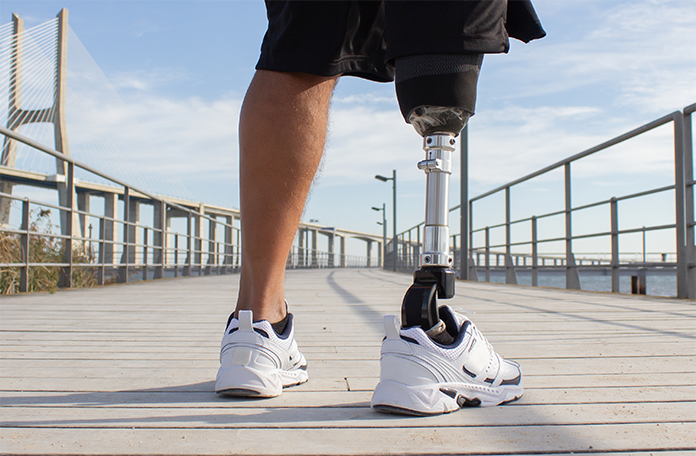
- Leg prostheses (above/below the knee): Intelligent knee assemblies are used, which adjust to your walking pace and the type of surface (stairs, sand, grass).
- Hand prostheses (higher/lower elbow): From functional and working nozzles to myoelectric prostheses, which are controlled by the impulses of your muscles, allowing you to perform small manipulations.
Technologies: Smart systems at your service
A modern prosthesis is a union of medicine and space technologies.
- Carbon fiber (Carbon): The carbon feet return energy when you step, working like a spring, allowing you to walk longer without feeling tired.
- Silicone liners: They are used for perfect fixation of the prosthesis. They protect the stump from irritation and provide comfortable wear even for 12+ hours.
- 3D modeling of stumps: We don’t just make a cast – we scan the stump to create an anatomically perfect sleeve that doesn’t press or chafe.
Preparation: Creating a foundation for successful prosthetics
The prosthesis will be comfortable only when the stump is prepared correctly. This stage lasts from 1 to 3 months:
- Stump formation: The use of compression knitwear to relieve postoperative swelling and give the stump the correct shape (cylindrical or conical).
- Skin and muscle preparation: Massages to reduce sensitivity (desensitization) and special exercises to strengthen the muscles that will control the prosthesis.
- Psychological adaptation: Help in accepting a new body image, which is the key to successful use of the prosthesis.
Prosthetic process: From mold to final product
Prosthetics is a technically complex process, which we divide into 4 steps:
- Diagnostics and taking measurements: Determining the patient’s activity level and 3D scanning of the stump.
- Test sleeve: Production of a temporary transparent sleeve. The patient walks in it for several days so that we can see the smallest pressure zones and correct them in time.
- Assembly and adjustment: Selection of modules (feet, knees, hands) and setting the right angles for perfect body balance.
- Cosmetic design: Giving the prosthesis the appearance and color of a healthy limb (at the patient’s request).
Rehabilitation methods: We learn to live and move in a new way
It is not enough to get a prosthesis, it is important to make it a part of yourself.
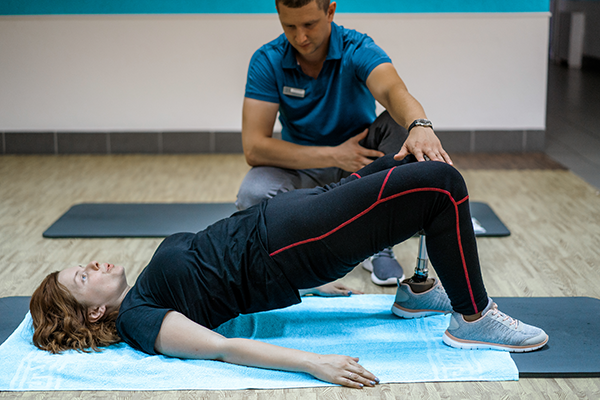
- Go to school: Training on special bars, learning to climb stairs and walk on uneven surfaces.
- Occupational therapy: For hand prostheses — teaching household skills (cooking, hygiene, using a smartphone).
- Overcoming phantom pain: Use of mirror therapy and physiotherapy to eliminate false sensations in the lost limb.